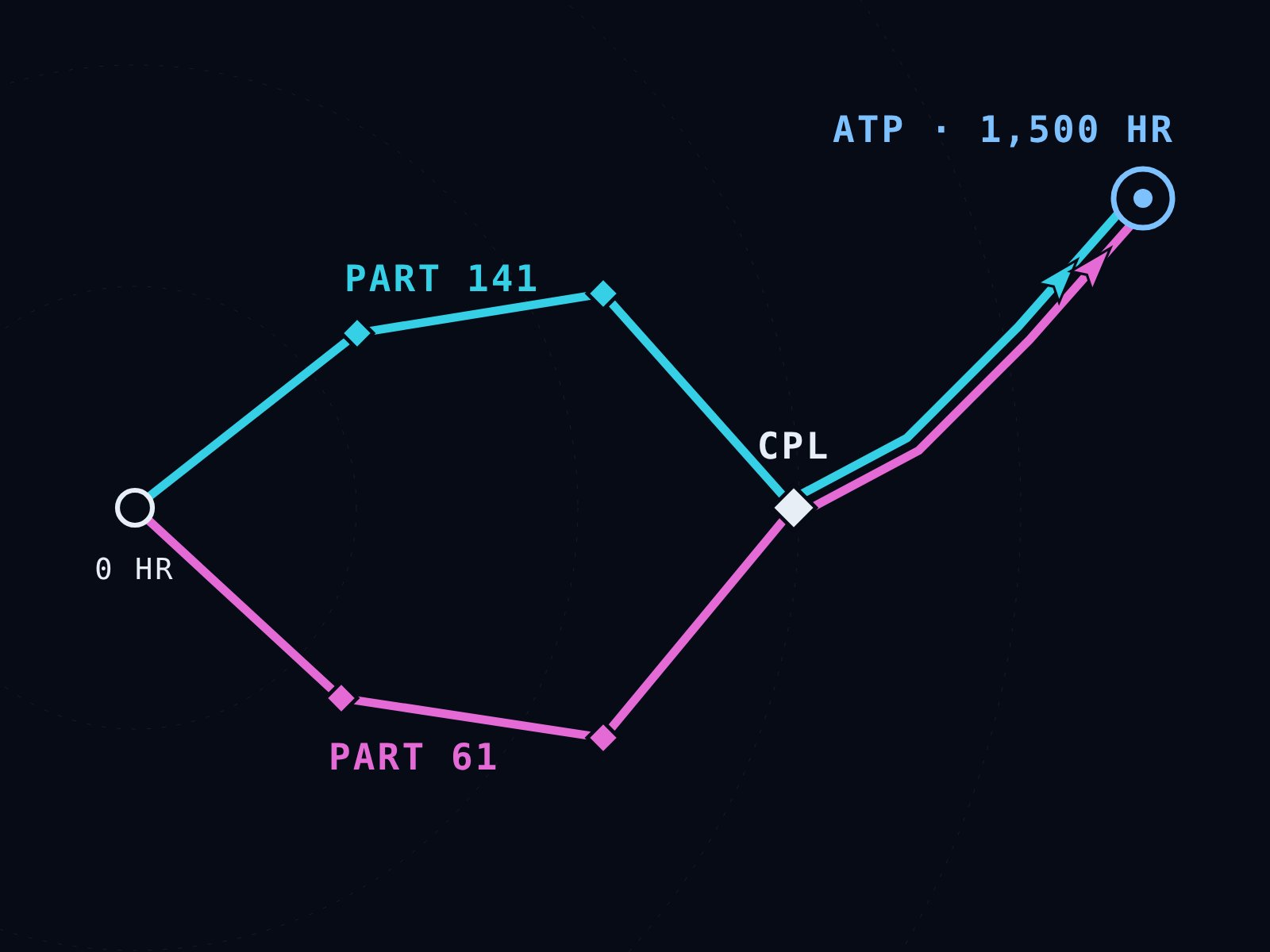
“Is it Part 61 or Part 141?” is one of the first questions people ask when they start comparing flight schools. It should be. But most of the answers online make the difference sound bigger than it is for someone headed to the airlines, and they skip the part that actually matters.
Here’s how I’d explain it to a student sitting across the table from me.
What the two parts actually are
Both are sections of the federal aviation regulations, and both lead to the exact same FAA certificates. A Commercial Pilot certificate earned under Part 61 is identical to one earned under Part 141. No airline checks which one you trained under.
Part 61 is the set of rules for pilots: what experience you need for each certificate. Any qualified instructor can train you under it, and the school decides how to structure the training.
Part 141 is a set of rules for schools. A 141 school has its courses approved by the FAA, has a chief instructor, gives stage checks at set points, and keeps detailed records. To keep its certificate, a 141 school has to show that at least 80 percent of its students passed their tests on the first attempt over the previous 24 months.
In exchange for that oversight, 141 students can qualify with fewer flight hours.
The hour difference
| Certificate | Part 61 minimum | Part 141 minimum |
|---|---|---|
| Private Pilot | 40 hours | 35 hours |
| Instrument Rating | 40 hours of instrument time, plus 50 hours of cross-country as pilot in command | 35 hours of instrument training |
| Commercial Pilot | 250 hours total | 190 hours total |
On paper, that’s a 60-hour head start to the Commercial certificate, and it’s the main reason Part 141 gets described as cheaper. In practice, that advantage mostly disappears, for two reasons.
First, almost nobody finishes at the minimum. Students under both parts routinely fly well past their minimums before they’re ready for a checkride. AOPA has long put the national average for a Private certificate at 60 to 75 hours, far above both the 35 and the 40. A student who’s ready at 60 hours is ready at 60 under either part, and you pay for the hours you actually fly. So the two paths usually reach each certificate at about the same point, and at about the same cost. The minimum is a floor, not a forecast.
Second, the real number is 1,500. An airline first officer needs an Airline Transport Pilot certificate, which requires 1,500 hours. Completing a Part 141 program does not lower that by itself. The reduced minimums are 1,000 hours for graduates of a qualifying four-year aviation degree, 1,250 for a qualifying two-year degree, and 750 for military pilots. If you’re not in one of those groups, both paths end at the same 1,500 hours.
Even in the best case for 141, a student who finishes right at the 190-hour minimum, those 60 hours come to about 4 percent of the climb to 1,500. You’ll fly most of the rest as a paid flight instructor either way.
When Part 141 genuinely matters
There are real reasons to choose 141, and I’d rather you know them up front:
- The GI Bill. If you’re a veteran using VA education benefits for flight training outside a college degree, the program generally has to be an FAA Part 141 course that’s also approved by the VA, and you typically need a Private certificate before benefits apply. Confirm the details with the VA.
- An aviation degree and the reduced ATP minimums. The 1,000- and 1,250-hour paths run through college aviation degree programs, which train under 141.
- Visa sponsorship. If you need a student visa, look for a school that can sponsor one. We can’t at this time.
If any of those apply to you, a Part 141 school is the right call, and I’ll tell you that directly.
When Part 61 is the better fit
Part 61’s strength is flexibility. A 61 program can adjust the order and pace of lessons to the student in front of it and to the weather outside, without waiting on approval to change a course. That matters in New England, where a week of low ceilings can wreck a rigid schedule.
The risk with Part 61 is that flexibility turns into no structure at all: a different instructor every week, no stage checks, no written standard, and a student who’s “almost ready” for months. That’s the kind of training I see the results of later, in the check seat.
What we chose, and why
VNAV Flight Labs is a Part 61 school following a Part 141-style syllabus. Every phase will have a written standard and a stage check before you move on, the same way a 141 course works. We keep the flexibility of 61 to adapt the schedule to the student and the weather.
The reason is simple. When I evaluate pilots at an airline, I can’t tell which regulation they trained under. I can tell whether they were held to a standard: whether they brief, whether they know what the airplane is doing, whether they’ve been checked by someone other than their own instructor. Structure is what produces that, and you can build structure under either part.
How to tell if a Part 61 school is actually structured
If you’re looking at any Part 61 program, ours included, ask:
- Is there a written syllabus? Can they show you, lesson by lesson, what you’ll do and what standard you have to meet?
- Who gives the stage checks? A check by someone other than your regular instructor catches what your instructor has stopped seeing.
- How is progress tracked? You should be able to see exactly where you stand at any point.
- What’s the first-time checkride pass rate? A 141 school has to keep it at 80 percent or higher. A 61 school should be willing to tell you theirs.
We’ve committed to publishing our own outcomes once we have real cohorts behind us (see our transparency page). For how the year itself is laid out, see What a Zero-to-CFI Program Actually Includes.
VNAV Flight Labs is preparing for its 2027 launch at Windham Airport (KIJD), Connecticut. See the full curriculum, or claim early access to apply 14 days before the public.