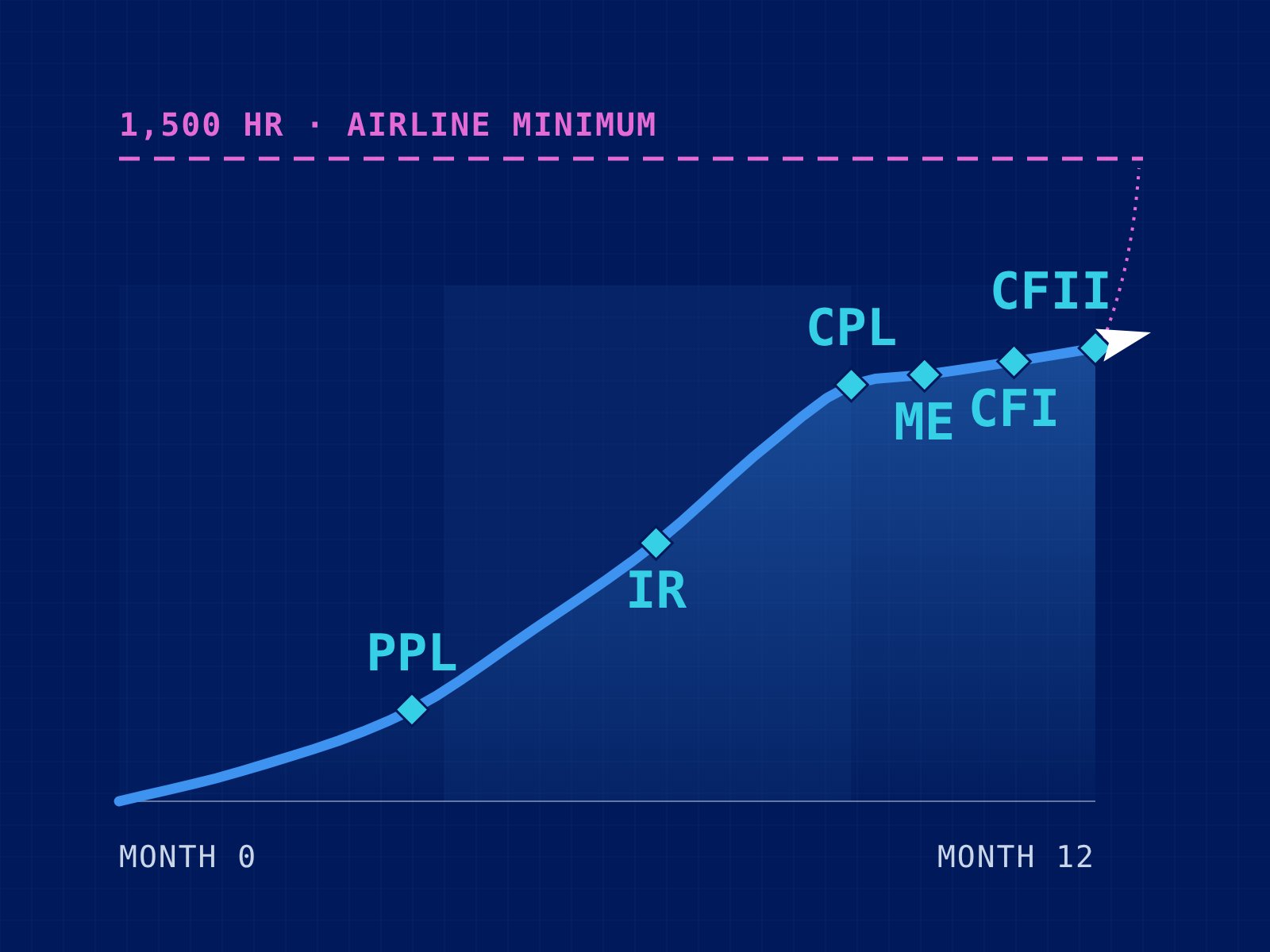
“Zero to CFI” is one of those phrases every career flight school uses and almost none of them unpack. It sounds simple: walk in with no flight time, walk out a flight instructor. What happens in between is six FAA checkrides, a stack of written exams, a couple hundred hours of flying, and one big mental shift most students don’t see coming.
If you’re comparing programs, here’s what that year actually looks like, phase by phase, and what to ask any school before you sign.
The year at a glance
| Phase | Planned length | What you earn | FAA checkrides |
|---|---|---|---|
| Private Pilot | 3–4 months | Private Pilot Certificate | 1 |
| Instrument & Commercial | 4–5 months | Instrument Rating, Commercial Pilot Certificate | 2 |
| CFI & Multi-Engine | 2–3 months | CFI, CFII, multi-engine rating, spin endorsement | 3 |
Those are our planning estimates for the first cohorts. Weather, examiner availability and your own pace all move them. More on that below.
- 1Private PilotAround month 4 · FAA minimum 40 hours
- 2Instrument RatingMonths 6–7 · 40 hr instrument, 50 hr cross-country
- 3Commercial PilotAround month 9 · 250 hours total
- 4Multi-EngineMonth 10 · add-on rating, plus spin endorsement
- 5CFIMonth 11 · learning to teach
- 6CFIIMonth 12 · instrument instructor
Months 1–4: Private Pilot
This is where you learn to fly the airplane: takeoffs, landings, stalls, navigation, emergencies, your first solo and your first solo cross-country. The FAA minimum for a Private Pilot certificate under Part 61 is 40 hours. Most students need more than the minimum, and any school that quotes you the bare minimum as a promise is setting you up to be disappointed.
The Private is also where habits get set, good or bad. That’s why every VNAV flight, including the very first one, will start with a structured brief (here’s why). By the time you take your Private checkride, you should have briefed and debriefed dozens of flights. That habit is worth more at an airline than anything on the checkride itself.
Months 4–9: Instrument and Commercial
This is the longest phase and the one that separates a hobby from a career.
Instrument Rating. You learn to fly by reference to instruments alone, in clouds, on approaches down to minimums. Part 61 requires 40 hours of actual or simulated instrument time and 50 hours of cross-country time as pilot in command before you can test. On bad-weather days, lessons will move to our flight simulator instead of being cancelled, and that time counts toward the rating within FAA limits.
Commercial Pilot. The big number here is 250 total flight hours under Part 61. That’s where most of your year goes. We plan to build those hours with purpose: real cross-country flights across the Northeast, into busier airspace and unfamiliar airports, not circles over the same practice area. You’ll also learn the commercial maneuvers (chandelles, lazy eights, steep spirals, eights-on-pylons), all of which can be flown and tested in our planned RV-12iS. Its glass cockpit counts as a technically advanced aircraft for the Commercial requirements, so you train and test in one airframe (why the glass matters).
Months 9–12: CFI, CFII and multi-engine
Here’s the mental shift. Up to now you’ve been learning to fly. Now you’re learning to teach someone else to fly, which is a different skill, and for many pilots the CFI checkride is the hardest one they take.
This phase covers:
- CFI: the Fundamentals of Instructing, how people learn, how to brief and debrief a student, and how to fly every maneuver from the right seat while explaining it.
- CFII: the instrument instructor add-on, so you can teach instrument students.
- Multi-engine rating and spin endorsement, delivered through our training partners and included in tuition.
When I evaluate first officers, I can usually tell who instructed seriously. They brief clearly, they explain what they’re doing, and they catch problems early because they’ve spent hundreds of hours watching someone else make mistakes. Instructing isn’t just a way to build hours. It’s some of the best airline preparation there is.
What 12 months doesn’t get you
You’ll finish with roughly the 250 hours the Commercial requires. Airlines generally require 1,500 hours for an ATP certificate, with some reductions for certain graduates. That gap is why the program ends at CFII: you close it getting paid to instruct, not paying to rent airplanes. Any program that suggests otherwise is skipping the most important part of the conversation. Our career path page walks through what each stage after that pays.
What can slow it down
I’d rather you hear this from us than find it out in month seven:
- Weather. New England winters are real. The simulator keeps you moving, but some flights have to wait.
- Examiner availability. Checkrides are given by FAA-designated examiners, and their calendars fill up.
- Maintenance. Airplanes need inspections. A single-type fleet makes that easier to plan around.
- Your own pace. Some maneuvers click on day one and some take a week. Our tuition already includes a buffer above the FAA minimums. If you need more time beyond that, extra instruction is billed at $315 an hour rather than ending your program.
Questions to ask any zero-to-CFI program
Whether you train with us or anyone else, get clear answers to these before you sign:
- Is it Part 61 or Part 141? Both can work. Know which one you’re buying and why. (We’re a Part 61 school following a Part 141-style syllabus, with stage checks at each phase. That gives you the structure of 141 with the scheduling flexibility of 61.)
- What exactly does the price include? Multi-engine? Spin training? Checkride fees? Housing? Our costs page lists what’s included and what’s extra.
- What happens if I need more hours than planned? Get the per-hour rate in writing.
- What’s the weekly schedule? Ours is planned at four flight days on, three off.
- Who built the syllabus, and what were they training for? A checkride, or a career?
- Will you publish your graduates’ outcomes? We’ve committed to publishing our placement numbers once we have real cohorts behind us (see our transparency page).
A good program can answer every one of those without hesitating.
VNAV Flight Labs is preparing for its 2027 launch at Windham Airport (KIJD), Connecticut. Tuition is $83,350, with about $9,000 in additional costs. See the full curriculum, or claim early access to apply 14 days before the public.